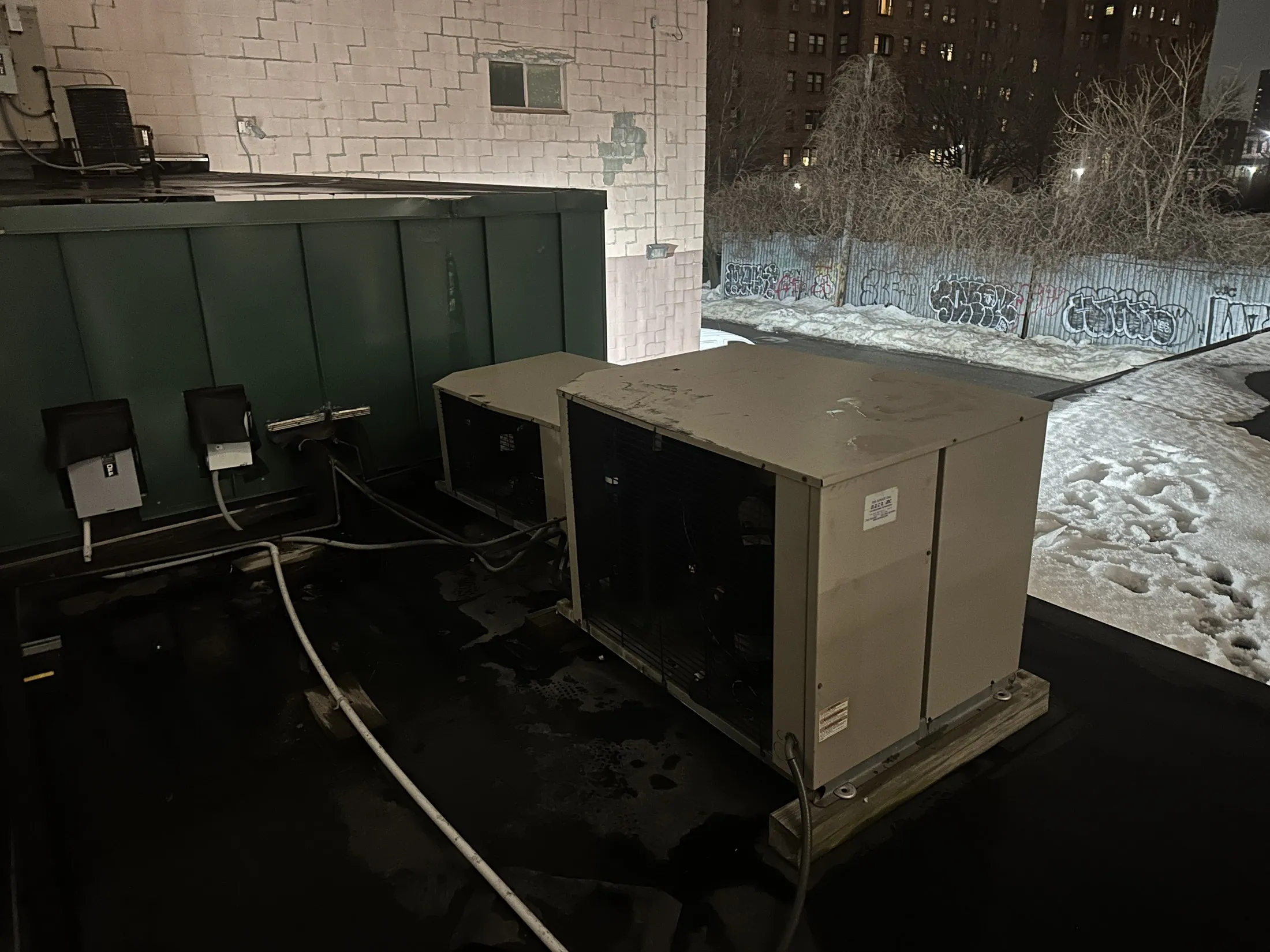
Winter in Greater Boston is hard on everything — including refrigeration. That surprises a lot of owners: why would a machine whose whole job is removing heat care about cold weather? Because commercial refrigeration is designed around moving heat from inside the box to the outside air, and when the outside air gets very cold, the system stops behaving the way it was designed to. Compressors short-cycle, evaporators starve, oil and refrigerant migrate where they shouldn't, and a unit that ran fine all summer starts failing on a 15-degree January night.
The good news: this is a solved problem. The hardware that protects refrigeration in cold weather — low-ambient controls — is mature, reliable, and far cheaper than a compressor replacement or a walk-in full of spoiled product. Here's what every owner should know.
Why cold weather breaks refrigeration
A refrigeration system rejects heat at the condenser. When the condensing temperature drops because it's 10°F outside, head pressure falls with it. That sounds harmless, but head pressure is what pushes liquid refrigerant through the metering device:
- Low head pressure starves the evaporator. The expansion valve can't feed enough refrigerant, the coil runs underfed, and box temperatures creep up — yes, your freezer can run warm because it's cold outside.
- Short cycling. Pressure switches and low-pressure cutouts trip on cold startups, and the compressor starts and stops repeatedly. Every start is wear.
- Refrigerant migration. When the compressor sits idle in the cold, refrigerant vapor condenses and migrates to the coldest spot in the system — often the compressor crankcase, where it mixes with the oil. On the next start, that mixture foams, oil leaves the compressor, and you get lubrication failure. This is the classic cold-morning compressor death.
- Shoulder-season swings. Spring and fall temperature swings — 65°F one day, 28°F the next — catch systems at their most vulnerable, exactly when nobody is thinking about winter yet.
The controls that protect you
Most walk-ins, reach-ins, and ice machines installed in the Northeast are — or should be — equipped with low-ambient protection. If yours isn't, it was probably sized and installed for mild weather, or the controls were skipped to cut the install cost:
- Condenser fan cycling controls. A pressure or temperature switch that cycles the condenser fan off when head pressure drops, keeping it from falling too far. Simple, effective, and the minimum protection for cold climates.
- Flooded head pressure controls ("headmasters"). A valve that floods part of the condenser with liquid refrigerant in cold weather, reducing the condenser's effective size so head pressure stays up. More sophisticated — and standard on properly installed walk-in systems in New England.
- Crankcase heaters. A small heating element on the compressor crankcase that keeps the oil warm and drives refrigerant out of the oil while the compressor is off. Cheap, silent, and essential for outdoor or cold-location compressors. It must be energized even when the compressor isn't running — which is why it should be verified, not assumed.
- Heated and insulated receivers. On larger systems, the receiver holds the extra refrigerant charge; keeping it from getting too cold keeps system pressure where it belongs.
- Variable-speed condenser fans. Instead of cycling on and off, the fan slows down — steadier head pressure, less cycling wear, quieter operation.
Ask your technician which of these your system has. "It runs fine in winter" is not the same as "it's protected in winter" — an unprotected system can run for years and then die in one bad February.
Where Boston buildings create low-ambient problems
- Rooftop and remote condensers get the full wind chill and the coldest overnight lows. If your unit lives on the roof, read our rooftop maintenance article first — access, flashing, and coil care all apply here too.
- Units in unheated spaces — loading docks, back alleys, attached sheds, commissary garages. A condenser in an unheated room sees outdoor temperatures all winter, and nobody thinks to check on it.
- Equipment near open dock doors faces constant cold blasts on top of wild temperature swings.
- Heat-reclaim setups that preheat domestic water or space air can leave the refrigeration side under-condensing when building heat demand drops — another fall-and-spring failure point.
Fall: the time to check
Early October is exactly when to verify low-ambient protection, before the first real cold snap:
- Confirm the crankcase heater is actually working — check continuity and that it's warm to the touch when the compressor is off. A dead heater is invisible until January.
- Have a technician verify fan cycling and head pressure controls by simulating low-ambient conditions, not just eyeballing the wiring.
- Check suction-line insulation — cold, wet, or missing insulation costs efficiency and invites sweating and drips.
- Make sure drain lines and defrost drains won't freeze where they exit the building.
- Walk-in door gaskets get stiff and brittle in the cold — check the seal now, especially on freezer doors.
- Review temperature logs and alarm setpoints; cold-weather faults look different from summer ones, and your alarms should catch them.
The bottom line
Cold weather doesn't give your refrigeration a break — it changes the failure mode. A system with proper low-ambient controls sails through a Boston winter. One without them is a January emergency waiting to happen, and January emergencies happen at 2 AM on the coldest night of the year.
If you're not sure your system has low-ambient protection — or you can't remember the last time anyone verified it — call Frostline Commercial Refrigeration at (857) 666-8916. We'll check your controls, test your crankcase heaters, and make sure your equipment is ready for what's coming. Before winter does the checking for you.